Digital marketing mistakes can make it difficult for businesses to reach the right audience, attract customers, and achieve their goals. Today, having an online presence is important for businesses of all sizes, whether you run a small shop, a local business, or a large company. A good digital marketing strategy helps you connect with potential customers, build trust, and promote your products or services. However, simply posting on social media or running ads does not always bring the results you expect. To grow online, you need to understand your audience, create useful content, choose the right marketing channels, and track your progress. By understanding common digital marketing mistakes and learning how to avoid them, you can improve your marketing efforts, use your budget wisely, and build a stronger online presence.
What Are Digital Marketing Mistakes?
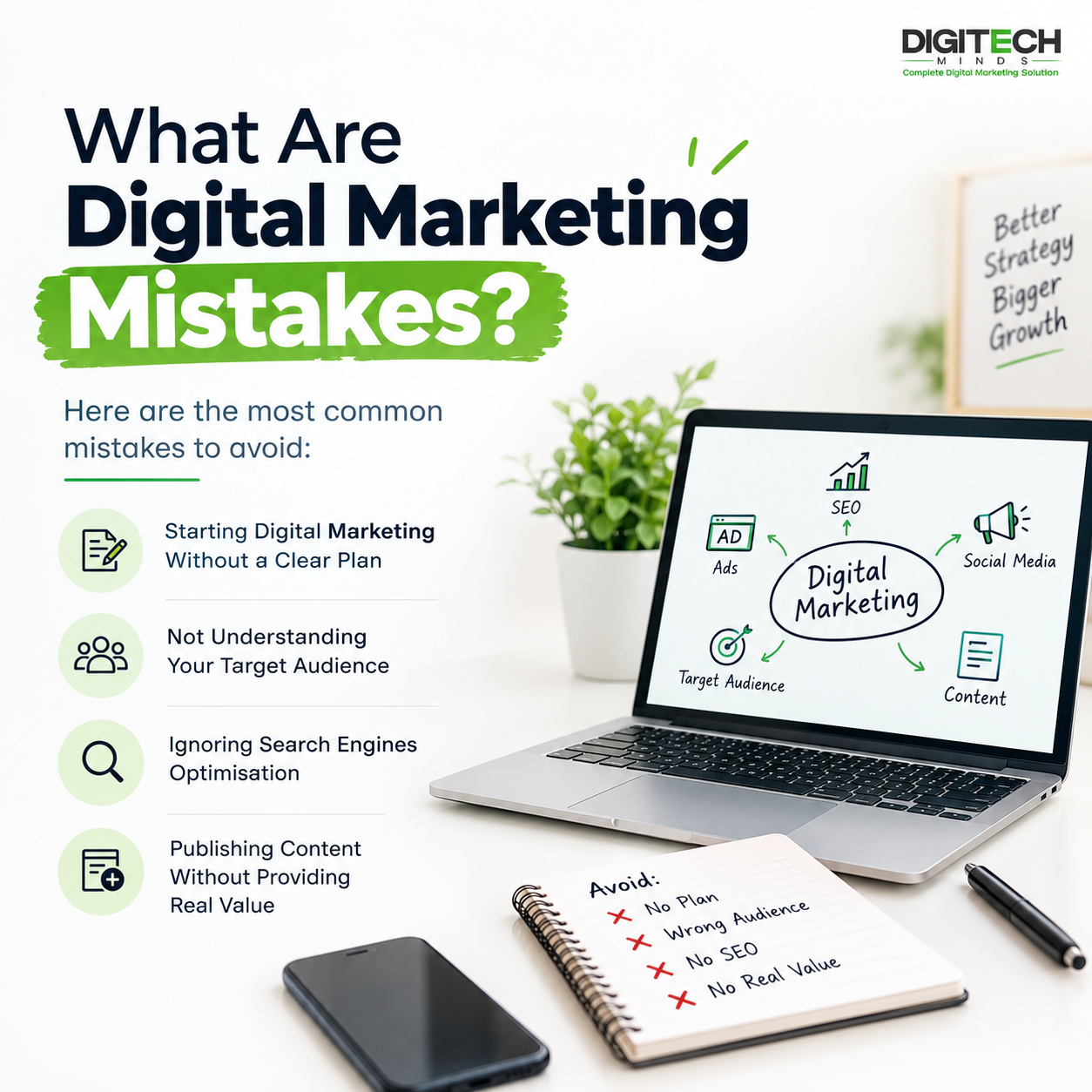
Digital marketing mistakes happen when businesses make the wrong decisions while promoting their products or services online. A successful digital marketing plan starts with clear goals. Businesses should first decide which customers they want to attract and what they hope to achieve. They can then choose the right marketing channels, such as social media, SEO, or paid advertising, and check their performance regularly to see what needs improvement .This helps them avoid wasting time and money and make smarter marketing decisions.
Many businesses make simple digital marketing mistakes. They may target the wrong people, use the wrong platforms, ignore their website, or run ads without a clear plan.
For example, a local bakery may post photos on Instagram every day but get very few orders. This could be because the posts do not show prices, the shop’s location, or how to order.
The problem may not be the products. The bakery may need better content and clear information to help customers order easily.
By learning what goes wrong in digital marketing, businesses can make smarter choices, improve their strategy, and work towards better results.
Starting Digital Marketing Without a Clear Plan
Many businesses begin digital marketing without setting specific goals. They may post content on social media or spend money on ads, but without a clear purpose, it becomes difficult to know whether their efforts are working. Before starting, set clear goals. Decide whether you want more website visitors, leads, sales, or brand awareness. Know who your potential customers are and focus on the platforms they use regularly. A well-planned strategy helps you manage your time and money better. It also allows you to measure your progress, see what is working, and make changes when needed.
How to avoid this mistake:
Start by choosing one main marketing objective. It could be increasing website traffic, generating enquiries, improving online sales, or building brand awareness.
Next, select suitable marketing channels and decide how you will measure progress. For example, a service business may focus on local SEO, Google Business Profile, and lead generation campaigns.
Check your marketing performance often and make changes to your plan based on what is working and what needs improvement.
Not Understanding Your Target Audience
Many businesses struggle with digital marketing because they do not clearly understand the people they want to reach. Your marketing message may be good, but it will not work if you show it to the wrong people.
Every business has different customers. Some people look for affordable products, while others care more about quality or service. When you know what your customers are looking for, you can create messages that match their interests and solve their problems.
Your target audience may include people For example, suppose you run a bakery in your neighbourhood. who want birthday cakes.
It may also include people who want fresh bread.
It may also include people who want sweets for special occasions. Sharing relevant offers and product photos can help you attract these customers.
How to avoid this mistake
Start by understanding your customers. Think about their needs, interests, budget, and problems.
Use social media comments, customer feedback, and website data to learn more about them
Ask your customers about their preferences, needs, and the products they would like to see.
Use what you learn from customers to create useful content that answers their questions and helps them solve everyday problems. When your content meets your audience’s needs, you can connect with the right people, earn their trust, and make your digital marketing more effective.
Ignoring Search Engine Optimization (SEO)
Search engine optimization (SEO) makes it easier for people to discover your website through Google search results. It helps search engines understand your content and show it to people who are looking for related information.
Many businesses publish content without researching the right keywords. They may also use unclear page titles, add unrelated keywords, or forget to link to other pages on their website.
For example, a web design company in Kotdwar might write, “We provide the best website services.” But this does not explain what the company does or how it can help customers.
A good page should explain the website design services, who they are for, and how customers can get in touch.
How to Avoid This Mistake
- Research keywords: Find out what your potential customers search for on Google.
- Write clear titles: Use page titles that explain what your content is about.
- Use keywords naturally: Add relevant keywords where they fit. Avoid repeating them too often.
- Add internal links: Link to other useful pages on your website.
- Write helpful content: Answer your readers’ questions and provide useful information.
Good SEO takes time, but these steps can help search engines understand your website and make it easier for people to find your content.
Publishing Content Without Providing Real Value
Content marketing can help businesses educate customers, answer questions, and build trust. However, publishing content regularly is not enough if the content offers little practical value.
Some businesses create generic blogs, repetitive social media posts, or promotional captions that focus only on selling. Readers may ignore this content because it does not address their problems or help them make decisions.
For example, a blog titled “Best Digital Marketing Tips” will be less useful if it contains only general statements such as “post regularly” and “use social media.”
Readers need specific advice, clear explanations, examples, and actionable steps.
How to avoid this mistake:
Before publishing content, ask yourself whether it answers a real question or solves a specific problem.
Include practical examples, explain difficult terms in simple language, and provide steps readers can follow. Use original insights from your experience whenever possible.
You should also review old content and update information that has become outdated.
Publishing a few well-written, helpful articles is often more useful than posting lots of content that repeats the same ideas.
Using Social Media Only to Promote Your Business
Social media marketing is also about connecting with people, sharing useful information, and building relationships with your audience, not just selling products or services. It is also an opportunity to build relationships, answer questions, share useful information, and develop brand recognition.
A common mistake is posting sales messages every day without considering what followers actually want to see.
For example, a restaurant can do more than just say “Visit us today.” It can share its menu, show its food, offer discounts, and post customer reviews.
How to avoid this mistake:
Create a balanced content plan that includes:
- Educational posts that provide useful information.
- Product or service posts that explain your offering.
- Behind-the-scenes content that shows the people and process.
- Customer stories or reviews shared with permission.
- Offers and promotional posts with clear terms.
- Interactive content that encourages genuine conversations.
Respond to relevant comments and messages, and review which types of posts generate meaningful engagement.
The aim is not to post more than everyone else. It is to publish content that gives your audience a reason to pay attention.
Running Paid Ads Without Proper Planning
Paid advertising on platforms such as Google, Facebook, and Instagram can help businesses reach potential customers. However, spending money on advertisements without a clear plan can lead to disappointing results.
Businesses often make mistakes with paid ads. They may choose the wrong goal, show ads to the wrong people, use unclear text, or forget to check their results.
For example, a business may want more customer enquiries but run ads just to get likes and comments. This may not help the business reach its goal. The campaign may receive interactions without generating the enquiries the business needs.
How to avoid this mistake:
First, identify the purpose of the campaign. Are you trying to increase awareness, attract website visitors, generate leads, or drive purchases?
Then, create an advertisement that matches this objective. Use a clear message, relevant visuals, and an appropriate call to action.
Make sure the destination page matches the promise made in the advertisement. If you are collecting leads, explain what customers will receive after submitting their details.
Track meaningful results such as qualified leads, purchases, cost per lead, and return on ad spend where appropriate.
Do not judge a campaign only by likes, reach, or impressions. Measure it against the original business goal.
Neglecting Mobile-Friendly Website Design
Many people use their phones to search for products and services. If your website is hard to use on a phone, they may leave without contacting you or making a purchase.
Common website problems include small text, confusing menus, large images, too many pop-ups, and buttons that are hard to click.
A website may look attractive on a desktop computer but provide a poor experience on a mobile device.
How to avoid this mistake:
Use a responsive website design that adapts to different screen sizes. Make text readable, keep navigation simple, compress large images, and ensure important buttons are easy to find.
Check that your website works well on mobile. Make sure people can fill out forms, call you, move between pages, and place orders easily.
Also, monitor your website performance using tools such as Google Page Speed Insights.
A mobile-friendly website makes it easier for visitors to find information and take the next step.
Ignoring Analytics and Campaign Performance
Without measuring results, it is difficult to know whether your digital marketing activities are working.
Some businesses use the same marketing plan for months without checking their results. They may ignore website visits, customer enquiries, ad costs, and sales. Others focus on likes and views instead of real business growth.
For example, a blog may get many visitors but few enquiries if the content does not reach the right people.
How to avoid this mistake:
Choose metrics that match your objectives.
For website performance, you can use Google Analytics 4 to understand traffic and user interactions. Google Search Console helps you monitor search impressions, clicks, indexing issues, and search queries.
For advertising campaigns, review relevant metrics such as cost per lead, conversion rate, and sales.
Ask three simple questions during each review:
- What is performing well?
- What is not meeting expectations?
- What should we change next?
Use the answers to make informed decisions rather than relying on assumptions.
Using the Same Content on Every Platform
Posting the same content everywhere may save time, but it does not always produce the best results.
Different platforms work best with different types of content. For example, a blog may work better on a website, while a short video may work better on Instagram.
The problem is not necessarily reusing content. The problem is failing to adapt it to the platform and its audience.
How to avoid this mistake:
Start with one useful idea and adapt it for different channels.
For example, a blog about common SEO mistakes could become:
- An Instagram carousel explaining five mistakes.
- A short video demonstrating one practical SEO improvement.
- A LinkedIn post discussing the business impact of poor SEO.
- A detailed website article covering all the mistakes.
Keep the main message consistent, but adjust the format, length, introduction, and call to action.
This approach helps you use your content more efficiently without making every post feel identical.
Neglecting Local SEO
Local SEO helps businesses reach people in their nearby areas. It is useful for restaurants, salons, coaching centers, repair shops, and marketing agencies.
People searching for website design in Kotdwar want to know what services a business provides and how to contact it.
If your website has incorrect business details or does not mention your location, customers may find it hard to find and trust your business.
How to avoid this mistake:
- Create or maintain an eligible Google Business Profile.
- Keep your business name, address, phone number, and hours accurate.
- Add relevant service details to your website.
- Create useful location-specific pages where they genuinely help customers.
- Encourage honest customer reviews and respond professionally.
- Keep contact information easy to find.
Avoid creating multiple low-quality pages that simply replace one city name with another. Each location page should offer useful, accurate information for people in that area.
Ignoring Email Marketing and Follow-Ups
Digital marketing does not end when someone visits your website or clicks an advertisement. Many potential customers need more information or time before they decide to purchase.
Businesses can miss opportunities when they fail to follow up with people who have voluntarily shared their contact details.
For example, someone may enquiry about a service but delay making a decision. A simple follow-up email can answer questions, explain the service, and help the customer decide what to do next.
How to avoid this mistake:
Build an email list using clear consent and explain what subscribers can expect. Send useful updates, educational content, offers, or service information that matches their interests.
For enquiries, create a simple follow-up process. Respond promptly, answer questions clearly, and make the next step easy.
Respect privacy requirements, provide an unsubscribe option where required, and avoid sending unsolicited bulk messages.
The purpose of email marketing is to maintain useful communication, not to overwhelm people with repeated promotions.
Expecting Immediate Results and Giving Up Too Early
Digital marketing takes time and regular effort. Some businesses expect quick sales from ads or want their new website to rank on Google within a few days. But results do not happen that quickly every time.
When results are slow, some businesses give up or try a different platform without finding out what went wrong.
Different marketing methods take time to show results. Paid ads can bring visitors to your website quickly, but they may not lead to sales. SEO takes longer and depends on your content, website quality, and competition.
How to avoid this mistake:
Set realistic goals and establish a review schedule.
Check how your ads are performing and make changes when needed. Don’t change your strategy just because of small ups and downs in results. For SEO, track relevant search queries, indexing, organic traffic, and conversions over time.
If results are weak, investigate the possible cause. The issue might be the offer, audience, content, website experience, or conversion process.
Be consistent, but do not confuse consistency with repeating an ineffective strategy forever. Continue testing and improving based on evidence.
How Can You Avoid Digital Marketing Mistakes?
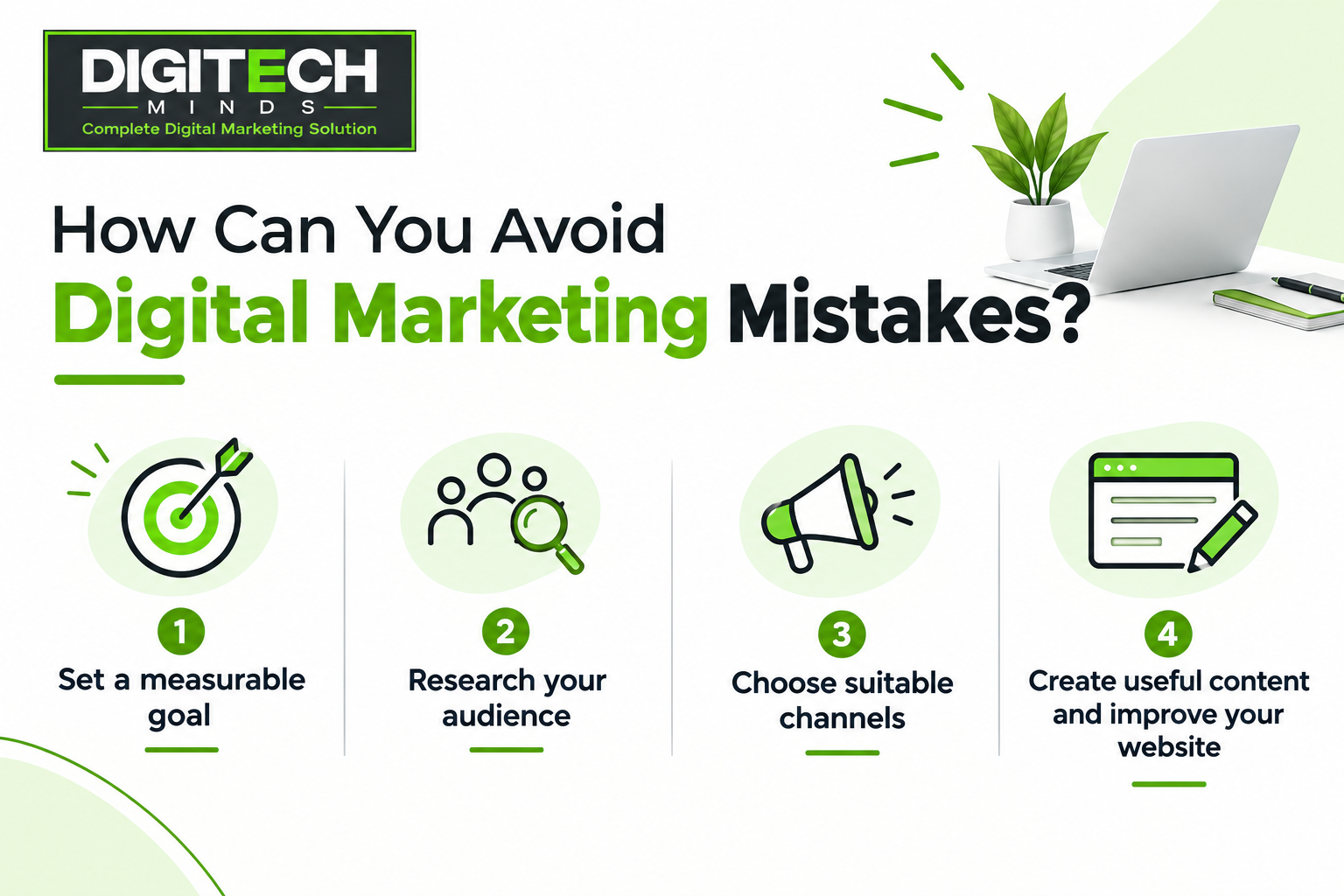
You do not need a large budget or a complicated marketing system to improve your digital marketing. Start with a clear plan and build better habits over time.
Here is a simple checklist:
Step 1: Set a measurable goal. Decide whether you want more enquiries, sales, relevant website traffic, or brand awareness.
Step 2: Research your audience. Understand their needs, questions, interests, and buying behaviour.
Step 3: Choose suitable channels. Focus on the platforms that support your goals instead of trying to do everything at once.
Step 4: Create useful content. Answer real questions and explain how your product or service helps customers.
Step 5: Improve your website. Make it mobile-friendly, easy to navigate, and clear about the next action visitors should take.
Step 6: Track performance. Use relevant analytics tools to measure progress against your goals.
Step 7: Review and improve. Identify what works, correct problems, and test changes systematically.
Small, well-informed improvements can make your marketing activities more focused and easier to manage.
Frequently Asked Questions (FAQs)
1. What are the most common digital marketing mistakes?
Businesses often make mistakes in digital marketing. They may work without a plan, target the wrong people, ignore SEO, share poor content, run ineffective ads, or forget to check their results.
Businesses can reduce these mistakes by setting clear goals, understanding their customers, and regularly reviewing performance.
2. Why do digital marketing campaigns fail?
Digital marketing campaigns can fail for many reasons. The offer may be unclear, the ads may reach the wrong people, or the website may not encourage visitors to take action. Poor tracking and unrealistic expectations can also lead to bad results.
To identify the problem, compare campaign results with the original objective and examine each stage of the customer journey.
3. How can small businesses avoid digital marketing mistakes?
Small businesses should have a clear plan, understand their customers, keep their business details correct, and share useful content. They should also check their results regularly.
Instead of trying every marketing platform, they should focus on the ones that best fit their goals and budget.
4. Is SEO important for digital marketing?
Yes. SEO can help people discover relevant website content through organic search results. It also supports website visibility and helps businesses answer questions potential customers are already searching for.
SEO works best when you also share useful content, make your website easy to use, and help visitors take the next step.
5. How long does digital marketing take to show results?
There is no fixed timeline. Paid campaigns can generate traffic quickly, although leads and sales depend on the offer, audience, and campaign quality. SEO and organic content may take months to build meaningful results, depending on competition and other factors.
Businesses should set realistic expectations and evaluate progress using appropriate metrics.
6. Which tools help prevent digital marketing mistakes?
Use Google Analytics to check website visits, Search Console to track Google results, PageSpeed Insights to check website speed, and Semrush to find keywords.
Choose tools based on your needs. Start with the ones that help you reach your goals.
7. Can a business do digital marketing without a large budget?
Yes, businesses can start with simple steps. They can improve their website content, update their Google Business Profile, find the right keywords, post useful content on social media, and ask customers for feedback.
Many free tools can help, but some have limits. Businesses can start using these tools and try paid ads when they have a clear goal and can track the results.
Conclusion
Avoiding digital marketing mistakes requires a clear plan, an understanding of your audience, and regular improvements. Businesses should focus on creating useful content, choosing suitable marketing channels, and tracking their results. Learning from common digital marketing mistakes can help businesses make better decisions, use their marketing budget wisely, and connect with potential customers. By staying consistent and improving their strategy over time, businesses can build trust, strengthen their online presence, and achieve long-term growth.