
A blog can be beautifully written and still get almost no organic traffic if it targets the wrong topic. The problem often starts before the writing begins: with weak or incomplete keyword research.
Good keyword research shows what people search for. It also shows how hard those searches may be. It tells you what kind of page ranks already.
Keyword research means finding and reviewing the words people type into Google. Then you pick the ones that fit your audience, search intent, and business goals.
For SEO content, the goal isn’t to collect hundreds of keywords. To find the right topics, understand what people want from those searches, and turn that information into useful content.
What Is Keyword Research?
Keyword research means finding the searches related to your business and figuring out which ones are worth targeting. You normally look at factors such as search volume, competition, keyword difficulty, relevance, and search intent.
For example, a local bakery might start with “cakes,” but that keyword is too broad. It does not show what potential customers truly want. After research, it might discover more specific searches such as:
- birthday cake delivery
- custom birthday cakes
- birthday cakes near me
- eggless birthday cake
- chocolate cake for birthday
Those searches reveal different needs. Someone searching for “birthday cakes near me” may be ready to buy, while someone searching for “birthday cake ideas” may still be researching. So, the content you create for those two searches should be different.
At Digitech Minds, we see keywords as topics with intent, not just words to add to an article.
Why Is Keyword Research Important for SEO?
Keyword research gives you a clearer idea of what to write before you spend hours writing the article. Without it, you may publish articles based entirely on assumptions about what your audience wants. Instead, you can see what people are actually searching for and build content around those questions, problems, and topics.
It helps you understand what people search for
Your customers may describe your product differently than you do. You may call it “content marketing services.” Your potential customer may search for “blog writing services” or “SEO content writing.” Keyword data can show you those differences.
It helps you choose better content topics
Suppose you’re a digital marketing agency and want to publish a post about SEO. Instead of randomly choosing “SEO tips,” keyword research can reveal more focused opportunities such as:
- SEO keyword research
- on-page SEO checklist
- how to find keywords for SEO
- SEO content writing
- keyword research tools
Each term can point toward a different content opportunity.
It helps search engines understand your content
Using relevant terminology naturally throughout a page helps search engines understand what the page is about. But this doesn’t mean repeating the same keyword every few sentences.
A useful article should cover the topic well. It should answer questions readers may have. It should use related terms when they fit.
It prevents you from targeting the wrong keywords
A keyword can have impressive search volume and still be a poor choice. For example, a small local accounting firm probably shouldn’t build its entire SEO strategy around “accounting.” The term is broad, competitive, and doesn’t tell Google which location or service the business serves.
A more specific term such as “tax accountant for small businesses” may have less search volume but much stronger business relevance.
The best keyword is not always the keyword with the biggest number.
How to Do Keyword Research Step by Step
You don’t need a complicated process. Start with a broad topic. Find related searches. Check the numbers. Review what Google shows. Then pick keywords that fit your business. Here’s how to do it.

Step 1: Start With a Seed Keyword
A seed keyword is a broad word or phrase you use as the starting point for your research. For a content writing agency, seed keywords might include:
- content writing
- blog writing
- SEO content
- website content
- keyword research
Don’t worry about finding the perfect keyword yet. You only need a few broad terms to start.
If you’re researching keywords for a local gym, for example, your seed terms could be “gym,” “personal training,” “weight loss,” and “fitness classes.”
From these broad terms, you can find more specific searches.
Step 2: Find Keyword Ideas
Once you have seed keywords, expand them using keyword research tools and Google’s own search features. Useful sources include:
- Google Keyword Planner
- Semrush
- Ahrefs
- Google autocomplete suggestions
- Related searches
- “People also ask” questions
- Competitor pages
These tools show related searches and useful metrics such as search volume and keyword difficulty.
For example, research “keyword research” to find related terms. These include “keyword research tool” and “free keyword research tool.” You may also see “how to do keyword research” and “keyword research checklist.”
Don’t immediately choose the first keyword with a large search volume. Build a list first so you can compare the options properly.
Step 3: Check Search Volume
Search volume estimates how often people search for a keyword within a particular period and location. It can help you estimate the potential demand behind a topic.
However, treat volume as one metric, not the final decision. A keyword with 10,000 searches may bring less useful traffic than a specific keyword with 500 searches. This is true if the specific keyword shows stronger buying intent.
| Keyword | Possible Intent | Potential Value |
|---|---|---|
| shoes | Very broad | Difficult to determine |
| running shoes | Product research | More specific |
| best running shoes for beginners | Commercial research | Stronger |
| buy running shoes online | Transactional | Very strong |
A keyword with fewer searches isn’t automatically better. You need to consider what those searches mean for your business.
Step 4: Check Keyword Difficulty and Competition
Keyword difficulty estimates how hard it is to reach Google’s first page for a search. It applies when you are not paying for ads. Tools like Semrush and Ahrefs score difficulty differently. So don’t treat the number as a guarantee that you will rank.
Use it to compare keywords and understand how competitive your options are. A good starting point is to look at four things together:
relevance + search demand + difficulty + business value
For example, “keyword research” has high demand, but it is also highly competitive. So, simply publishing a general article may not be enough to rank quickly.
You can target the main topic. You can also create helpful content for specific searches. Examples include “how to do keyword research for SEO” and “keyword research checklist.”
Step 5: Understand Search Intent
Search intent is simply the reason behind a search. Before creating content, ask:
What does the person actually want when they type this query into Google? The four common categories are:
Informational intent
The searcher wants to learn something. Examples:
- what is keyword research
- how does SEO work
- how to find keywords for SEO
Commercial research
The searcher is comparing options before making a decision. Examples:
- best keyword research tool
- Semrush vs Ahrefs
- best free keyword research tool
Transactional intent
The searcher is ready to take an action, often making a purchase or booking a service. Examples:
- SEO content writing services
- hire a blog writer
- buy keyword research service
Navigational intent
The searcher already knows the website, brand, or platform they want to visit. Examples:
- Semrush login
- Google Keyword Planner
- Ahrefs
The content needs to match that purpose. If most results for a query are detailed guides, a sales page may struggle to satisfy the search. Likewise, if people are looking for a service page, a 3,000-word educational article may not be the right format.
Step 6: Look at the Search Results
Don’t rely only on keyword metrics. Search the keyword yourself and study the current results. The SERP, or Search Engine Results Page, is simply the page Google shows after you search for something.
Look at:
- What type of pages rank?
- Are they guides, product pages, category pages, or tools?
- How detailed are they?
- What questions do they answer?
- What information seems missing?
- Are the results focused on beginners or experienced users?
For example, if you search “how to do keyword research” and most results are step-by-step tutorials, readers expect that. Creating another vague definition page will not meet their needs.
Give the basic answer first, then add clear explanations, examples, and useful information that other pages may not have.
Step 7: Choose Primary and Secondary Keywords
Once you’ve analyzed your keyword list, choose one main keyword for the page. That becomes the primary keyword. Then select closely related terms that help you cover the topic naturally.
For this article, for example:
Primary keyword: keyword research
Supporting terms include:
- how to do keyword research
- SEO keyword research
- keyword research tool
- free keyword research tool
- keyword research checklist
- keyword research template
- how to research keywords
- how to do keyword research for SEO
These terms shouldn’t become a checklist of phrases you have to force into every section. Use them where they genuinely help explain the subject.
How to Choose the Right Keywords for Your Website
Once you’ve checked the numbers, bring the decision back to your business. Does this search actually match what you sell, who you serve, and what you can explain well?
A useful keyword should answer three simple questions:
What are people searching for? Does it match what your business offers? Can your content genuinely answer it?
Search Volume vs Keyword Difficulty
High search volume can mean more potential traffic, but it often comes with stronger competition. Low-difficulty keywords may be easier to target, but they might have limited demand. The useful opportunity is often somewhere between the two.
For newer websites, long-tail keywords can sometimes provide a practical starting point. A long-tail keyword is simply a more specific search, usually with more detail than a broad keyword.
For example:
- “SEO” is broad.
- “SEO for small business websites” is more specific.
- “how to do SEO for a small business website” gives even more context.
Long-tail does not necessarily mean extremely long. The main idea is that the search is more specific.
Relevance vs Traffic Potential
Imagine a website selling accounting software. The keyword “accounting” might have huge demand, but it isn’t specific enough.
“Accounting software for small businesses” provides much more context.
The broader keyword may have more searches, but the specific query better matches the product and its buyers. Traffic only becomes useful when it comes from people who value what you offer.
Short-Tail vs Long-Tail Keywords
Short-tail keywords are generally broad and concise:
- SEO
- marketing
- shoes
- content writing
Long-tail keywords are more specific:
- how to do keyword research for SEO
- SEO content writing for small businesses
- best running shoes for beginners
Short-tail searches can have large audiences, but they often tell you less about what the searcher wants.
Long-tail searches give you more context, which makes them especially useful for targeted blog content.
Business Intent vs Informational Intent
Not every keyword needs to sell something. Informational content can introduce your business to people earlier in the buying process.
Someone might first search:
how to write SEO content
Later, they may search:
SEO content writing services
You can create useful content for both stages without turning every educational article into an advertisement.
Best Keyword Research Tools
No single tool is perfect for every keyword research task. The right choice depends on what you need to find, how much data you want, and how much you are willing to spend.

Google Keyword Planner
Google Keyword Planner is a useful starting point for finding keyword ideas and checking estimated search demand. To use it, enter a few words related to your business and review the keyword ideas Google gives you. Find searches that closely connect to your products, services, or customers. Pay attention to:
- Keyword ideas you had not considered
- Estimated search volume
- Competition
- Related searches
- Different wording people use for the same service
The main decision it can help you make is which topics deserve further research.
For example, if you offer website development, start with “website development.” Then compare related searches for website design, business websites, eCommerce websites, or development costs.
One key detail: Google built Keyword Planner for Google Ads. Its competition metric reflects ad competition, not organic SEO difficulty. Use it mainly for keyword discovery and search-demand research.
Semrush
Semrush is useful when you want more than basic keyword ideas. It helps you compare difficulty, intent, and competition for a search.
Start by entering a keyword into its keyword research area. Look at the estimated search volume, keyword difficulty, search intent, related keywords, and the pages already ranking.
You can use that information to answer questions such as:
- Is this keyword relevant to my business?
- Is the competition realistic for my website?
- Are there more specific keywords worth targeting?
- What type of content are competitors creating?
- Are there related searches I should cover in the same article?
For example, if “keyword research” is highly competitive, investigate related searches. Try “how to do keyword research” or “keyword research checklist.” Then compare the opportunities.
The tool doesn’t decide for you. It gives you more information to make a better one.
Ahrefs
Ahrefs can help with keyword research, competitor analysis, backlink research, and content analysis.
For keyword research, enter your topic and review related keyword ideas, search volume, difficulty, and the pages currently ranking. Its competitor research features can also answer a different question: What topics are similar websites already getting traffic from?
That can be useful when you already know your main services but need ideas for content.
For example, you can study a competing website. You can review the keywords its pages rank for. Then identify topics that matter to your audience.
If you’re comparing Ahrefs with another tool, don’t focus only on how many keywords each platform displays. Consider whether the data is useful for the decisions you actually need to make.
Free Keyword Research Tools
You don’t always need an expensive SEO platform to start. Google search suggestions, related searches, Google Keyword Planner, and free keyword tools can provide useful starting data. A simple process is often enough:
- Search your main topic on Google.
- Note the autocomplete suggestions.
- Check the related searches near the bottom of the results.
- Look at “People also ask.”
- Put the useful ideas into a spreadsheet.
- Use a keyword tool to check their search volume and difficulty.
This gives you a starting list before you decide whether you need a paid SEO platform.
How to Do Keyword Research for Blog Content
Keyword research becomes useful when you connect it directly to content planning. A blog shouldn’t exist simply because you found a keyword. The keyword should help you identify a problem, question, or topic worth answering.
Find Topics Your Audience Actually Searches For
Start with the problems your customers frequently ask about. If you’re a web designer, for example, customers might ask:
- How much does a website cost?
- How long does website development take?
- What pages should a business website have?
- How do I get my website on Google?
These questions can become keyword research starting points. You can then check how people phrase those questions in Google and whether there are related searches worth covering.
How to Do Keyword Research for Blog Content
Keyword research becomes useful when you connect it directly to content planning. A blog shouldn’t exist simply because you found a keyword. The keyword should help you identify a problem, question, or topic worth answering.
Find Topics Your Audience Actually Searches For
Start with the problems your customers frequently ask about. If you’re a web designer, for example, customers might ask:
- How much does a website cost?
- How long does website development take?
- What pages should a business website have?
- How do I get my website on Google?
These questions can become keyword research starting points. You can then check how people phrase those questions in Google and whether there are related searches worth covering.
Group Related Keywords Into One Content Topic
Don’t create a separate article for every tiny variation of the same query. For example:
- how to do keyword research
- how to research keywords
- how to conduct keyword research
could potentially be addressed within one strong guide. Grouping similar searches helps you write one full article. It avoids making several short pages on nearly the same topic.
Match Keywords to Search Intent
Once you’ve grouped your keywords, use the intent to decide what kind of page should answer them.
A “what is” query may need a straightforward educational explanation.
A “best” query may require a comparison.
A “how to” query needs a process.
A “buy” or “hire” query generally needs a commercial or service page.
This simple check can save you from spending hours writing the wrong type of article.
Decide Which Keyword Should Be the Primary Keyword
Choose the keyword that best represents the page as a whole. Don’t select it solely because it has the highest search volume.
Consider:
- Relevance to the business
- Search intent
- Search demand
- Keyword difficulty
- Ability to create genuinely useful content
- Commercial relevance
For example, if three related keywords could all be answered by the same article, choose the one that best describes the main topic. Use the others naturally within the content rather than creating separate pages without a clear reason.
Turn Keyword Research Into a Blog Outline
Once your keyword group is ready, turn it into a logical structure. For example, research around “keyword research” naturally leads to sections covering:
- What keyword research is
- Why it matters
- How to do it
- Keyword difficulty
- Search intent
- Keyword research tools
- Keyword research checklist
- Keyword research templates
- Common mistakes
This makes the writing process much easier. Instead of staring at a blank document, you already know which questions the article needs to answer.
Keyword Research Checklist
Use this checklist before writing your next SEO article.
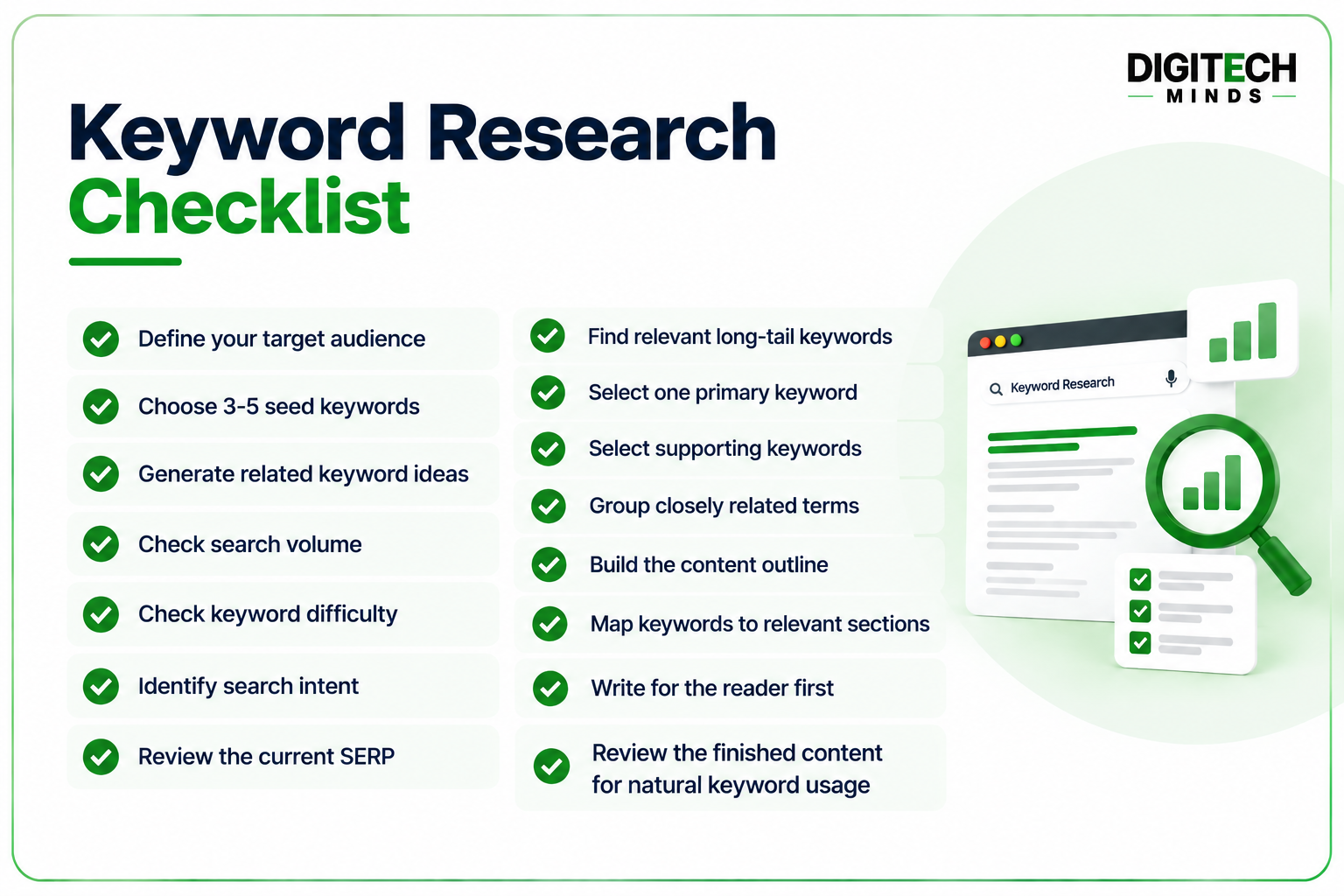
Keyword Research Checklist
- Define your target audience
- Choose 3-5 seed keywords
- Generate related keyword ideas
- Check search volume
- Check keyword difficulty
- Identify search intent
- Review the current SERP
- Find relevant long-tail keywords
- Select one primary keyword
- Select supporting keywords
- Group closely related terms
- Build the content outline
- Map keywords to relevant sections
- Write for the reader first
- Review the finished content for natural keyword usage
You can make keyword research much more complicated than this. For most small businesses, you don’t need to.
Keyword Research Template
A basic spreadsheet is enough to organize your research.
| Keyword | Intent | Volume | Difficulty | Business Relevance | Content Type | Priority |
|---|---|---|---|---|---|---|
| Keyword A | Informational | 1,000 | 40 | High | Blog | High |
| Keyword B | Commercial | 500 | 35 | High | Landing page | High |
| Keyword C | Informational | 300 | 25 | Medium | Blog | Medium |
| Keyword D | Transactional | 150 | 20 | High | Service page | High |
You can add columns for:
- Current ranking URL
- SERP features
- Competitor pages
- Content status
- Internal links
- Publishing date
If you’re a small business, you probably don’t need a spreadsheet with 10,000 keywords. A simple list of useful topics you can actually create content for is often enough.
Common Keyword Research Mistakes
Most keyword research mistakes happen after the data has been collected. The problem is choosing the wrong conclusion from it.
Choosing Keywords Only Because They Have High Volume
This is one of the most common mistakes. A high-volume keyword can be broad, highly competitive, or unrelated to your business. Before targeting it, ask yourself: Are the people searching for this keyword actually potential customers?
Ignoring Search Intent
If the search results mostly show tutorials and you are creating a product page, you may be using the wrong content format. Check the search results before writing and make sure your page matches what people are looking for.
Targeting Extremely Competitive Keywords
Competitive keywords are fine, but don’t rely on them too much when your website is new. Mix them with relevant, lower-difficulty keywords that are easier to target.
Using Too Many Keywords in One Article
Adding 50 keyword variations does not make an article more optimized. If two keywords have the same topic and intent, you can naturally use them in one piece of content. Cover the topic well, but don’t force keywords into every paragraph. Write for the reader first.
Choosing Keywords That Don’t Match the Business
A keyword can bring traffic and still be useless. If the visitor has no reason to need your product or service, that traffic may not contribute much to the business. Look at the actual connection between the search, the visitor, and what you sell.
Writing for Keywords Instead of People
Search engines need context, but your reader still needs a clear answer. If a sentence sounds awkward because you inserted a keyword into it, rewrite the sentence.
You don’t need to write:
“Our keyword research services provide keyword research for businesses that need keyword research.”
That isn’t optimization. It’s bad writing.
FAQ: Keyword Research
What is keyword research?
Keyword research means finding what people search for when they look for something related to your business. You can then use this information to choose topics and keywords worth creating content for.
How do you do keyword research?
Start with seed keywords and find related ideas. Check search volume, difficulty, and intent, then review the search results. Choose primary and supporting keywords. Use them naturally in helpful content. Do not just add them to an article.
How do you research keywords for SEO?
For SEO, look at relevance, search volume, difficulty, search intent, and the current search results. Tools like Google Keyword Planner, Semrush, and Ahrefs can help. But pages that already rank should also guide what you create.
How do you do keyword research for SEO?
Start with a relevant topic, find related keywords, check the metrics and search intent, and review competing pages. Then choose a primary keyword and supporting keywords that you can cover with useful content.
How do you find keywords for SEO?
You can find SEO keywords with Google search suggestions and related searches. You can also use Google Keyword Planner, Semrush, and Ahrefs. Check competitors and review customer questions too. Start with keywords related to your business, then expand them into more specific searches.
What is the best free keyword research tool?
There isn’t one free tool that is best for every situation. Google Keyword Planner is a useful starting point for keyword ideas and search demand estimates. Free versions of other SEO tools can add more keyword and competitor insights.
Final Thoughts
Good keyword research doesn’t tell you exactly what to write. It gives you the information you need to decide what to write about. It also helps you know who you are writing for. It shows what that reader expects to find.
The process can be kept simple:
Find the search → understand the intent → evaluate the opportunity → plan the content → answer the query better.
If you have a keyword list but lack time to turn it into clear, SEO-focused content, professional support can help.
At DigiTech Minds, we turn your keyword research into SEO blog content. It helps readers and boosts search visibility. If your business needs regular SEO content, start with a focused content plan instead of publishing articles randomly.
#Website Design in Kotdwar, Uttarakhand
October 13, 2026[…] Keyword Research tools can provide estimates of search volume and competition. These estimates are useful for comparison, but they do not guarantee traffic or rankings. For local service pages, use location-specific phrases only when they accurately describe the service you offer. […]