You publish a blog, optimize it for on-page SEO, add a few headings, and wait for the rankings to move.
Sound familiar?
The problem isn’t always that your content is bad. Sometimes, a page needs a few small changes to show its value. A better title helps. A stronger structure helps. Smarter internal links help. Content should match what people want to know. That’s the idea behind on-page SEO.
It isn’t about chasing every SEO rule or repeating the same keyword until the content feels unnatural. Making small, intentional changes helps your page make sense to your readers first, and to search engines along the way. And sometimes, those small changes are exactly what a page needs.
For businesses like DigiTech Minds, on-page SEO is not just about adding keywords. It helps make pages easy to understand, easy to use, and useful for visitors.
What Is On-Page SEO?
On-page SEO means improving a webpage’s content and HTML to make it easier to understand and rank in search results. It includes elements such as:
- Page titles and meta descriptions
- H1, H2, and H3 headings
- Keyword placement
- Search intent
- Content quality and depth
- URLs
- Internal links
- Image optimization and alt text
- Content freshness
- User experience
In simple terms, on-page SEO helps answer two important questions:
For search engines: “What is this page about?”
For users: “Does this page give me the answer I need?”
When both answers are clear, your page has a stronger foundation for organic visibility.
Why Does On-Page SEO Matter?
Creating good content is just one part of SEO. You should also structure your page content well. This helps search engines understand it. It also helps visitors find information easily. A well-optimized page can:
- Improve topic relevance
- Help search engines understand your content
- Help visitors find answers faster
- Improve internal linking
- Increase the chances of getting clicks from search results
- Improve visibility for relevant searches
- Help AI search systems understand your content
However, on-page SEO cannot guarantee a specific ranking position.
Google uses many signals to rank pages. These include relevance, quality, helpfulness, authority, technical factors, and search context. On-page SEO is one part of a broader SEO strategy, working alongside technical improvements, content, and other optimization efforts.
That is why the goal shouldn’t be “optimize everything for a ranking.”
The better goal is:
Make the best possible page for the searcher’s question—and make its purpose obvious.
10 On-Page SEO Elements That Can Improve Your Rankings
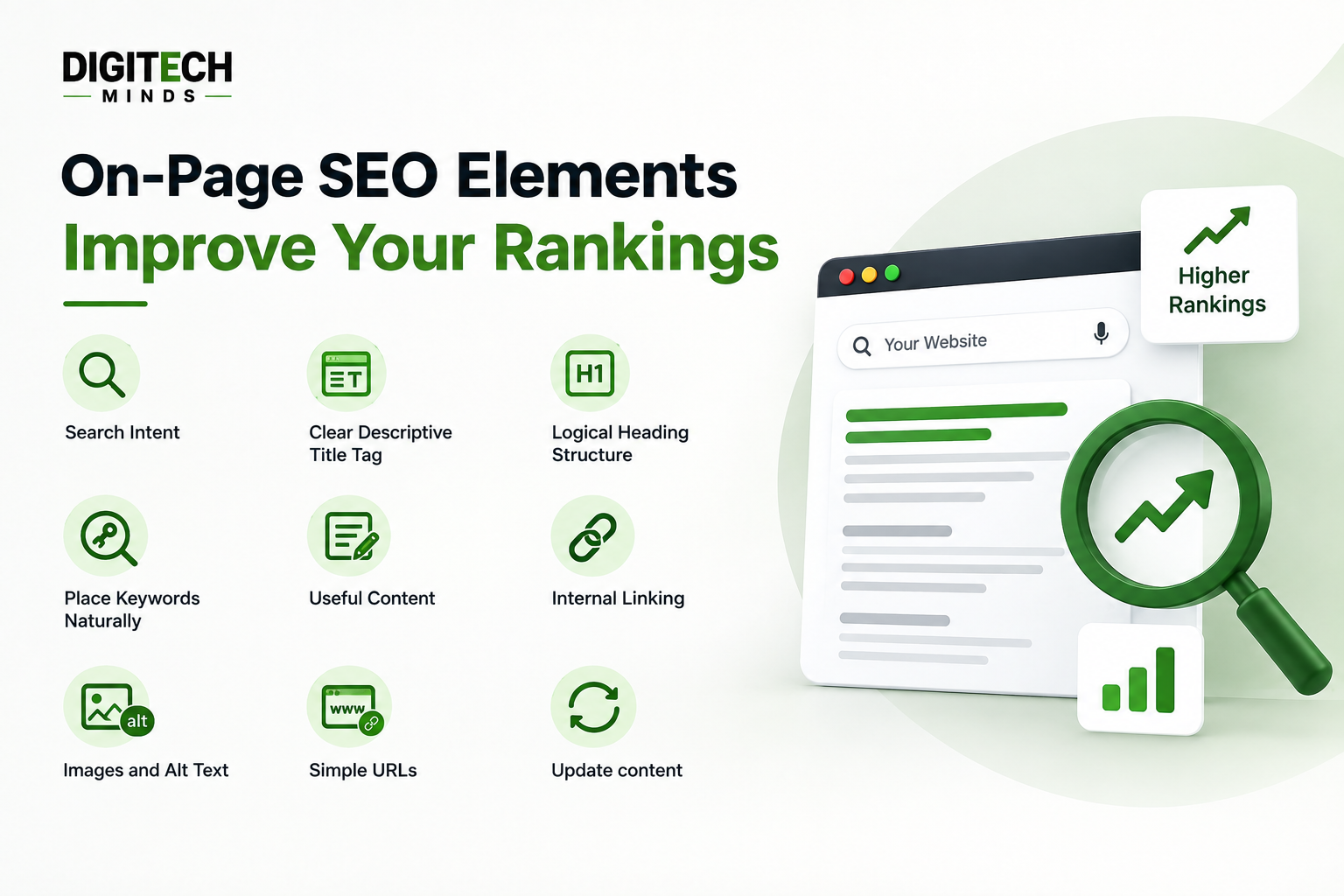
1. Match Search Intent First
Before you optimize a page, first understand what the person is actually looking for.
For example, someone searching “what is on-page SEO” wants a simple explanation. Someone searching “on-page SEO checklist” wants a list they can follow. And someone searching “on-page SEO services” may be looking for an SEO agency or service provider.
So, before you start writing, ask yourself:
“What does this person actually want to find?”
Then create your content around that.
2. Write a Clear, Descriptive Title Tag
Your SEO title is one of the first things people see in search results. A good title should clearly tell them what the page is about and give them a reason to click.
For example:
On-Page SEO: Small Changes, Better Rankings
It is clear, simple, and tells readers what to expect.
Avoid titles that only repeat the same keyword:
On-Page SEO | On-Page SEO Techniques | On-Page SEO Guide
This may look SEO-friendly, but it doesn’t give readers a strong reason to click.
3. Use a Logical Heading Structure
Headings make your content easier to follow. Your H1 should clearly show the main topic. Use H2s for main sections and H3s for smaller points.
For example:
- H1: On-Page SEO: Small Changes, Better Rankings
- H2: What Is On-Page SEO?
- H2: Why Does On-Page SEO Matter?
- H2: Important On-Page SEO Elements
- H3: Search Intent
- H3: Title Tags
- H3: Internal Linking
This simple structure makes long content easier to read and scan.
4. Place Keywords Naturally
Keywords help search engines understand what a page is about. But SEO is not about repeating the same keyword again and again. Use your main keyword naturally and add related words and topics where they fit.
For an article about on-page SEO, relevant terms might include:
- on-page optimization
- SEO content optimization
- internal linking
- search intent
- title tag optimization
- image optimization
- alt text
- heading structure
- content freshness
This creates stronger topical context without making the content sound robotic.
Write for humans first. Optimize for search engines second.
5. Create Content That Actually Answers the Query
Good content matters more than using keywords again and again. Give readers clear answers to what they are searching for.
Skip unnecessary introductions and get to the useful information quickly. Use simple language, add examples when helpful, and answer the important questions about the topic.
For example, instead of simply saying:
“Internal links are important for SEO.”
Explain what they are, why they matter, and how someone can use them. That’s the difference between mentioning a concept and actually helping the reader. That’s why content marketing and SEO often work best together.
6. Improve Internal Linking
Internal links connect one page of your website to another. They help visitors find related content and help search engines understand your website better. For example, a blog about on-page SEO could naturally link to content covering:
- Technical SEO
- Off-page SEO
- Keyword research
- Content marketing
- SEO audits
Use descriptive anchor text where appropriate rather than relying on generic phrases such as “click here.”
A strong internal linking structure helps connect blog posts into a topic cluster, instead of separate pages.
7. Optimize Images and Alt Text
Images can make content easier to understand, but poorly optimized images can slow down your page. Use the right image size, clear file names, and helpful alt text when needed.
For example:
Weak:
image123.jpg
Better:
on-page-seo-checklist.png
Alt text should describe the image’s meaningful content rather than becoming a place to insert keywords repeatedly.
8. Keep URLs Simple
A clean URL helps communicate a page’s subject. For this article, a suitable URL structure could be:
/blog/on-page-seo-small-changes-better-rankings/
Avoid unnecessarily long URLs that repeat the same keyword in multiple ways. A good URL should be:
- Short
- Descriptive
- Easy to read
- Relevant to the page
9. Refresh Content When It Becomes Outdated
SEO is not a “publish once and forget” process. Search trends, information, businesses, and competitors keep changing. So, review your important pages from time to time and check:
- Are the examples still useful?
- Are the statistics up to date?
- Are all links working?
- Does the content match what people are searching for?
- Can you explain any section more clearly?
- Is there any new information worth adding?
Updating old content can make it more useful for both readers and search engines.
10. Make the Page Easy to Read
One of the simplest on-page improvements is also one of the easiest to overlook. Don’t make visitors fight through a wall of text.
Use:
- Short paragraphs
- Descriptive headings
- Bullet points
- Tables where useful
- Bold emphasis for important ideas
- Clear examples
- Plenty of visual breathing room
Good SEO content should be easy to scan before it is read.
On-Page SEO vs Technical SEO vs Off-Page SEO
SEO is more than just the content on your website. On-page, technical, and off-page SEO focus on different areas.
| SEO Type | Main Focus | Examples |
|---|---|---|
| On-Page SEO | Content and page elements | Titles, headings, keywords, internal links |
| Technical SEO | Website infrastructure | Crawling, indexing, site speed, structured data |
| Off-Page SEO | External authority | Backlinks, mentions, digital PR |
Think of it like this:
On-page SEO helps search engines understand your page.
Technical SEO helps search engines access and understand your website.
Off-page SEO helps build your website’s trust and authority.
A good SEO strategy needs all three.
On-Page SEO Checklist
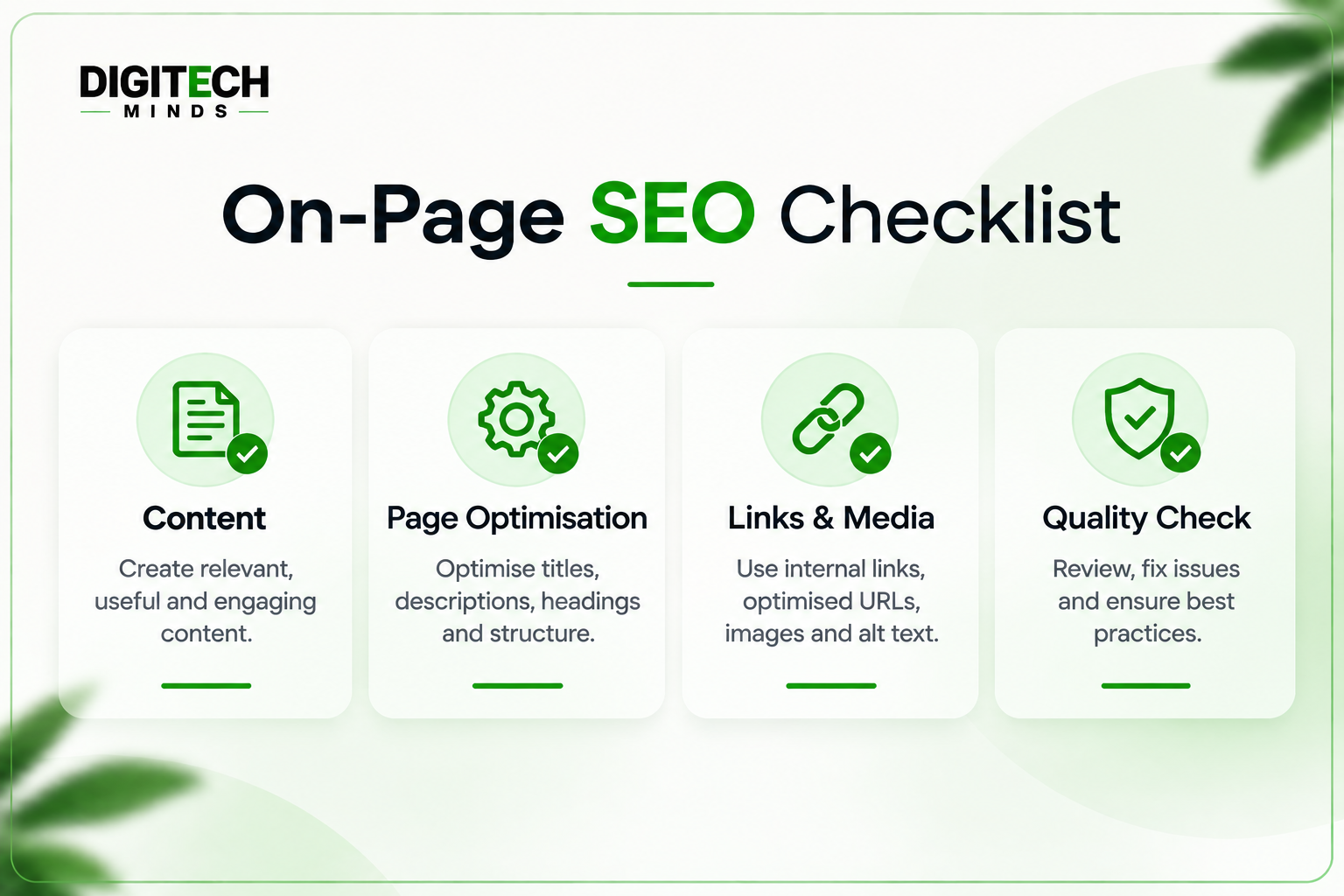
Before publishing a page, run through this quick checklist:
Content
- Search intent is clear
- Content answers the main question
- Information is useful and original
- Related questions are covered
- Keywords are used naturally
Page Optimization
- One clear H1 is present
- H2s and H3s follow a logical structure
- Title tag is descriptive
- Meta description is useful and compelling
- URL is short and relevant
- Primary topic is clear early in the content
Links & Media
- Add relevant internal links
- Link useful external sources when needed
- Optimize images for better performance
- Add clear alt text to important images
Quality Check
- Content is easy to scan
- No unnecessary keyword repetition
- No broken links
- Information is up to date
- Page works well on mobile
Small checks like these can prevent surprisingly common SEO mistakes.
How to Do On-Page SEO: A Simple Process
If you’re wondering how to do on-page SEO, don’t overcomplicate it. Follow this five-step process:
Step 1: Find the Search Intent
Understand what people expect when they search for your target topic.
Step 2: Build the Content Around That Intent
Answer the main question first, then cover important related questions.
Step 3: Optimize the Page Elements
Improve your title, headings, URL, meta description, images, internal links, and keyword placement.
Step 4: Make the Content Easier to Understand
Remove unnecessary wording, break up long sections, and use examples wherever they improve clarity.
Step 5: Review and Improve
Check the page after publishing. Look at search performance, user behavior, and whether the content still satisfies the query. This process is more sustainable than trying to “hack” rankings with excessive keyword usage.
How to Check Your On-Page SEO
No single Google-approved on-page SEO score tells you if a page will rank. Instead, check your page from different angles. For more guidance on how Google evaluates and understands web pages, you can also refer to Google Search Central’s SEO documentation.
- Content: Does it satisfy the search intent?
- Relevance: Does the page clearly cover the topic and related concepts?
- Structure: Are the title, H1, headings, links, and content logically organized?
- Experience: Can users quickly find and understand the information?
- Technical Foundation: Can search engines crawl and index the page properly?
- Performance: Is the page generating impressions, clicks, rankings, and meaningful organic traffic over time?
Tools can help find issues, but a tool’s score is only a signal. It does not guarantee rankings.
Common On-Page SEO Mistakes to Avoid
Even well-written websites can lose opportunities because of simple mistakes.
- Keyword Stuffing: Repeating the same keyword again and again does not make your content better.
- Writing for Search Engines, Not People: If your content sounds robotic, readers will notice.
- Ignoring Search Intent: Even a well-optimized page can perform poorly if it does not match what people want.
- Weak Internal Linking: Good content can get missed if you don’t connect related pages.
- Ignoring Existing Content: Sometimes updating an old page is better than always creating new content.
- Using the Same Keyword on Every Page: Targeting the same keyword on multiple pages can create confusion.
- Focusing on Just One SEO Element: SEO is not only about title tags. A good page needs different SEO elements to work together.
How On-Page SEO Helps AI Search and Google AI Overviews
Search is becoming more conversational. People now ask full questions instead of using short keywords. AI tools like Google AI Overviews, ChatGPT, Gemini, and Perplexity can also combine information from different sources.
That’s why clear and well-structured content is important. To make your content easier for search engines and AI tools to understand, focus on:
- Clear definitions
- Direct answers
- Simple headings
- Short explanations
- Relevant topics and concepts
- Complete topic coverage
- Original information and useful examples
- A clear flow between sections
- Reliable supporting information
For example, if someone asks:
“What is on-page SEO?”
A strong page should provide a clear definition near the beginning—not make the reader search through 1,500 words to find it.
Likewise, if someone asks:
“How do you do on-page SEO?”
A page that shows a clear step-by-step process is easier to understand. It may also be easier for answer-focused search tools to use. However, there is no guaranteed formula for getting your content included in an AI-generated answer.
The best approach is still the same:
Create genuinely useful, clear, well-organized content that deserves to be referenced.
On-Page SEO Is About Small Improvements That Add Up
SEO can sometimes feel like a competition where everyone is looking for the next significant game-changing trick. But sustainable SEO often works differently.
- A better title.
- A clearer H1.
- A more useful introduction.
- Better internal links.
- Cleaner URLs.
- More descriptive image alt text.
- A stronger answer to the user’s actual question.
- None of these changes alone guarantees higher rankings.
Together, however, they can create a page that is significantly easier to understand and more useful to its audience. That’s the real value of on-page SEO.
At Digitech Minds, we believe SEO is more than using keywords. We focus on making every important page clear, useful, and relevant to the people searching for it. We help businesses use SEO to improve their content, visibility, and search performance.
Whether you need an SEO audit, content optimization, or a complete SEO strategy, our team can help you make simple changes that can improve your results.
Frequently Asked Questions
What is on-page SEO?
On-page SEO means improving a webpage so it is easy to understand and useful for people and search engines. It includes content, headings, keywords, links, URLs, and images.
Which on-page element carries the most weight for SEO?
No single SEO element can guarantee rankings. Focus on search intent and useful content, then support it with clear titles, headings, links, and other page elements.
How do I do on-page SEO?
Start with search intent and create useful content that answers the query. Optimize your title, headings, URL, keywords, links, images, and readability. After publishing, check the page and improve it when needed.
What is the difference between on-page and off-page SEO?
On-page SEO focuses on things within your website, like content, titles, headings, URLs, and internal links. Off-page SEO focuses on things outside your website, like backlinks, mentions, and online authority.
Is on-page SEO the same as technical SEO?
No. On-page SEO focuses on your page content, titles, headings, and other page elements. Technical SEO focuses on the technical side of your website, like crawling, indexing, and site access.
How can I check my on-page SEO?
Check your page for search intent, content, keywords, headings, links, images, readability, and technical issues. SEO tools can help, but no single score can guarantee rankings.
How often should I update on-page SEO?
No fixed schedule exists. Update important pages when the information is outdated, search intent changes, or better information is available. Make sure each update adds real value.
Does on-page SEO help with AI search?
Clear and useful content helps search engines and AI tools understand your page. Use clear headings, direct answers, useful information, and trustworthy sources. But no single SEO tactic can guarantee visibility in AI-generated answers.
Final Takeaway
On-page SEO doesn’t have to be complicated. Start with small improvements. Understand search intent. Write a clear title. Organize headings. Improve the content. Add internal links. Optimize images. Make the page easier to use. Don’t optimize a page just because an SEO checklist tells you to.
Optimize it because a better page gives people a better answer.
And when your content is truly useful, clear, and easy to understand, you do more than improve today’s search results. You build a stronger base for the changing world of search.